Friday, August 10, 2012

Too Precious to Plant

If you've been reading All the World in a Blade of Quack, you may have read about my struggle to find the perfect place to plant one perfectly beautiful, hot pink hardy hibiscus.  When I brought it home from the greenhouse years ago, the petals lazed back like five Kleenexes wired together for a kindergarten craft project.  The stamen, though, was intricately detailed, cream-colored and lacy.  The stalk itself stood barely taller than the single bloom it bravely held intact.  Yes, the little hibiscus was way too precious to plant just anyplace.  It demanded, in its own delicate-but-in-your-face style, nothing less than center stage. Well, to read the whole tale, you'll have to check out Chapter 15, but suffice it to say that I finally found a place, and the hibiscus found that place to its liking.  Several years later, it is three feet tall, three feet wide, and still dazzling passersby.  When the rest of the garden is satisfied with just being green during the dog days of August, the hibiscus isn't satisfied with anything less than stardom.  It really ought to be in movies.

Monday, July 30, 2012

Cowboy in the Garden


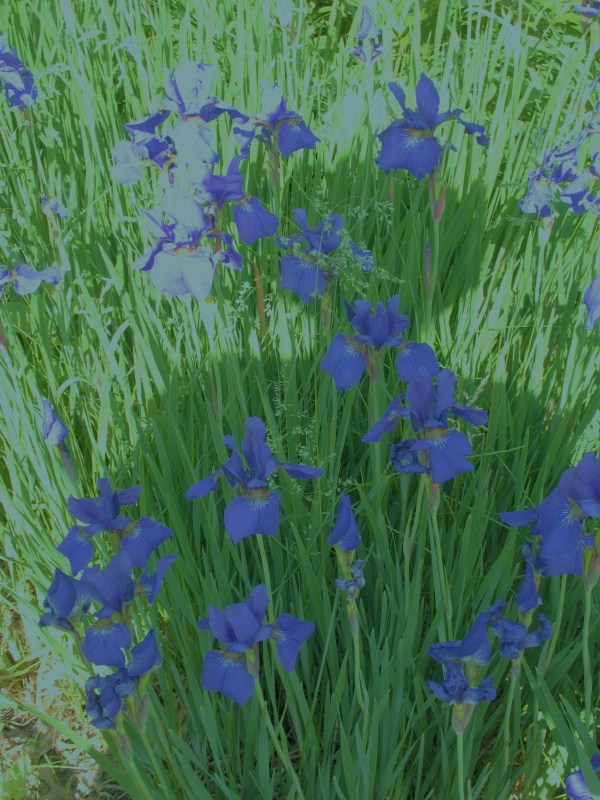
Who is this unknown creature hulking over the Siberians? I'm not saying anything except to quote an old saying: The best light for plants is the gardener's shadow.

Saturday, July 28, 2012

Oxalis Revisited


After weeks of drought when it was too dry to pull weeds in the garden, and a couple of days of rain after which it was too wet to pull weeds, I finally got deep into the garden yesterday. Wow. I never knew oxalis could could grow in such abundance. Well, maybe I had, yet I tended to leave it in place because a) it didn't really seem like a bad weed to me because it is kind of pretty, and b) during the dry weather I thought it might actually help shade the roots of other plants. Whether it did, or whether it actually sucked water away from them I cannot say, but whatever the case, all flowers and weeds seem to have come through the drought reasonably well. Nevertheless, yesterday was the day to rip out oxalis. I felt a little ungrateful. And now I am hoping that the drought does not return until all of the little oxalis plants I missed can grow big again.


Tuesday, June 26, 2012

Baby Hostas


This basket o' baby hostas was all decked out for my book launch. The first ten book buyers each got a tiny hosta to take home, a tiny hosta that self-seeded into my lawn just like the ones I tell about in All the World in a Blade of Quack: Reclaiming a Garden, Growing a Gardener. Here's part of the story:
"As I trim along the edge of the shade garden with our trusty Lawn Boy in late June, something catches my eye a couple of feet ahead of the mower. I manage to halt before I get to it and there, sure enough, growing in the grass, I see what looks like a tiny hosta. I hold back for a moment, afraid it might be a plantain, but finally I get down on hands and knees for a closer look and decide to take a chance."

Friday, June 22, 2012

Hero of the Hail


Astilboides in bloom! (The other greenery with roundish leaf, significantly smaller, is a climbing hydrangea which is finally learning to climb.) I have been happily growing astilboides for its gigantic, round leaves. Imagine my surprise to find it would bloom, too. Reminiscent of cimicifuga or giant tiarella, the bloom (panicle) is a delicate bit of froth on top of mighty leaves. My mightiest leaf was ripped apart by hail back in May, and so is probably feeling a little embarrassed about being flashed around on the Internet. The cool part of its story, however, is that the big leaf sheltered the smaller leaves under it. They weren't damaged at all. Everybody, altogether now: "Awwwwww."

Wednesday, June 20, 2012

Great Solomon's Seal


Jumping Jehosaphat! It's Great Solomon's Seal (Polygonatum)! Here is a woodland plant so uncommonly elegant you won't be able to believe it grows wild. If held straight up, it can measure over five feet tall. Because it prefers beauty to stature, however, it arches gracefully at about three and a half. Last year I tried moving one and found it to have a long rhizome similar to an iris. The plant arcs out over that, so the root acts as a fulcrum, keeping the whole thing from falling over. Great Solomon's Seals spread and can become kind of a nuisance, but they are beautiful--and if you have too many of them you can cut one near the ground and bring it in as a dramatic cut flower. (This requires a substantial container, something well weighted in the bottom.) Another plus: you can say "Great Solomon's Seal!" as an exclamation of joy. (Nobody really knows what "Jumping Jehosaphat!" means, anyway.)

Tuesday, June 12, 2012


An art gallery is the perfect place to talk about color, right? So at my book launch party at Crossings at Carngie last Sunday, I read a segment from All the World in a Blade of Quack: Reclaiming a Garden, Growing a Gardener that describes one of my many colorful experiences in learning to garden. The passage describes how, in my quest to get rid of quack, I try covering up an area of grass with clear plastic, which is supposed to kill the grass within two weeks. Needless to say, in my garden, success is elusive:
"After six days, the grass begins to yellow. Then the plastic comes loose in a few places and green springs up anew within hours. I batten down the proverbial hatches again and wait. Six days. Yellowing. Green. After two weeks, I have spots of brown and spots of yellow and spots of green. Well, a garden is for color, after all. Clearly (no pun intended) this plastic is not working quite as well as promised."


Of course, it wasn't all about reading and gardening at the party. It was about food and feasting, too. Lots of people liked the Roquefort Grapes. The recipe comes from Entertaining by Martha Stewart. I tried to find a link to the recipe on Martha's website, but couldn't, so here it is, with thanks to Martha Stewart for giving us a wonderful, easy recipe:

Roquefort Grapes
50 Hors D'Oeuvres
----
1 10-oz. package almonds, pecans or walnuts
1 8 Oz. package cream cheese
1/8 lb. Roquefort cheese
2 T. heavy cream
1 lb. seedless grapes, red or green, washed and dried

To toast nuts, preheat oven to 275 degrees. Spread nuts on baking sheet and bake until toasted. Almonds should be a light golden brown; pecans or walnuts should smell toasted but not burned. Chop toasted nuts rather coarsely in food processor or by hand. Spread on a platter.

In the bowl of an electric mixer, combine the cream cheese, Roquefort, and cream
and beat until smooth. Drop clean, dry grapes into the cheese mixture and gently
stir by hand to coat them. Then roll the coated grapes in the toasted nuts and put
on a tray lined with waxed paper. Chill until ready to serve.

Serve piled on a plate garnished with a ring of lime slices and/or mint leaves.

Note from Coleen: I did almost three pounds of grapes with this amount of cheese.
For the recipe to be successful, grapes must be completely dry.